
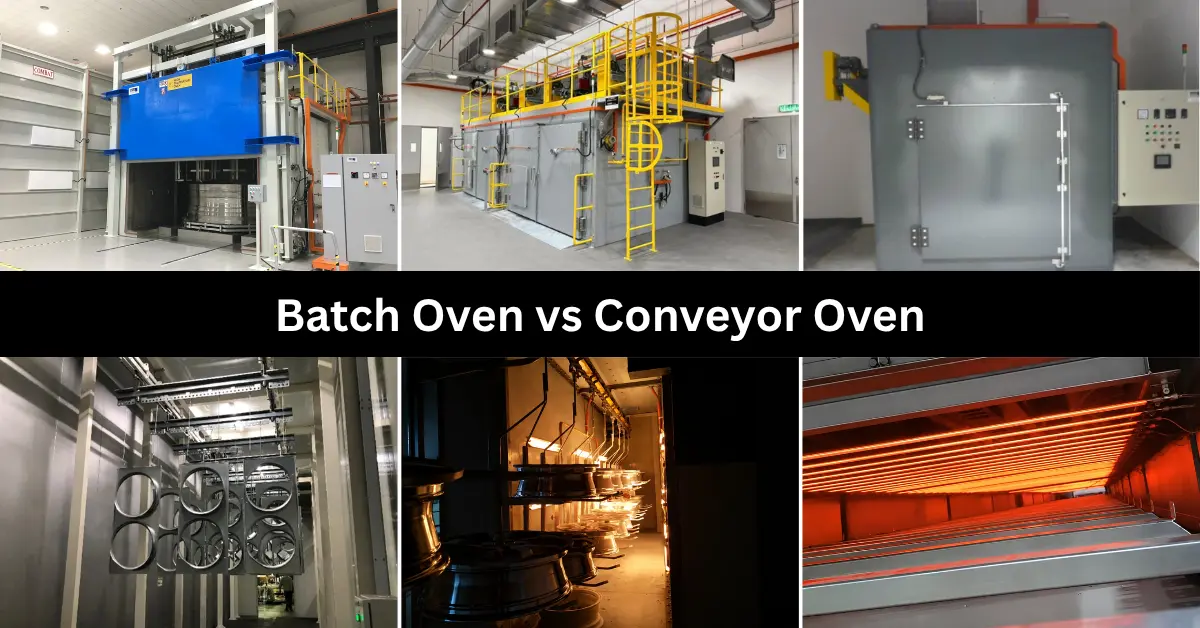
Choosing the right industrial oven is an important decision for manufacturers looking to improve production efficiency, maintain product quality and meet specific thermal processing requirements.
Two common solutions used in industrial manufacturing are batch ovens and conveyor ovens. Both can be designed for applications such as drying, heating and coating curing, but they differ in how products are loaded, processed and moved through the production workflow.
The main difference between a batch oven and a conveyor oven is the way products move through the heating process. A batch oven processes a group of products within a chamber during a defined cycle, while a conveyor oven transports products through a heated system for continuous processing.
Understanding how each system works can help manufacturers identify the most suitable solution for their production volume, product requirements and factory layout.
What Is Batch Oven?
A batch oven is an industrial heating system designed to process a group of products at one time. Products are loaded into an enclosed chamber, heated according to specified process conditions and unloaded when the cycle is complete.
Batch ovens are commonly used in manufacturing operations that require flexibility between production runs or involve products with different processing requirements.
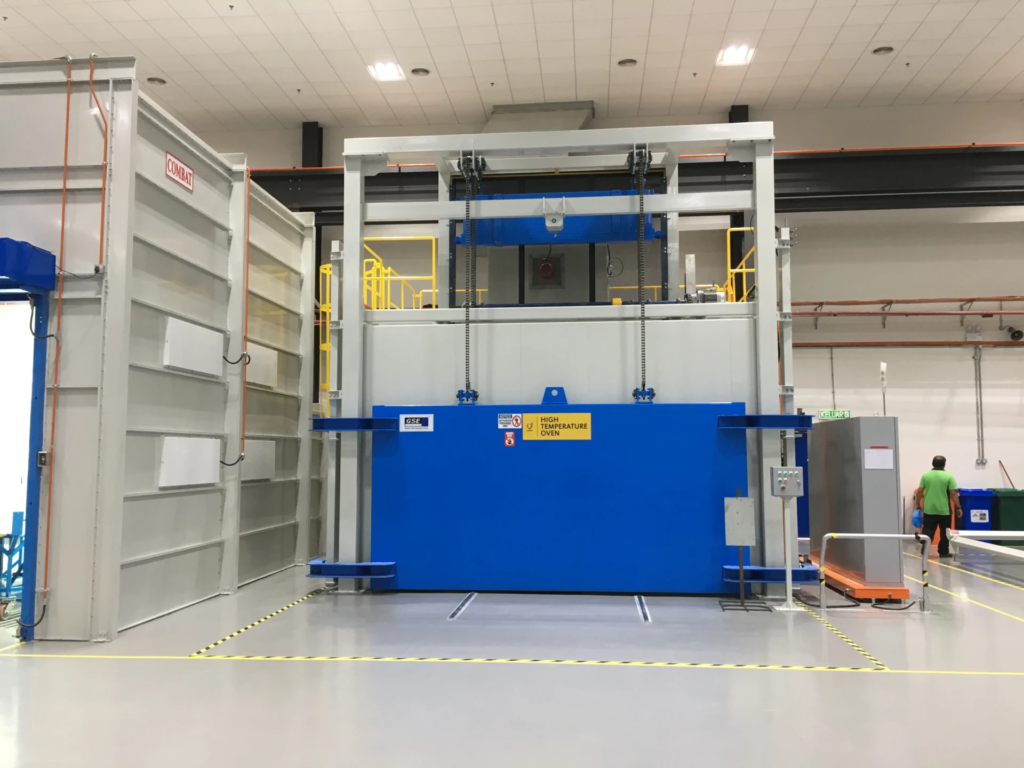
How Does Batch Oven Work?
A typical batch oven operates through several stages:

Loading
Products are placed inside the oven using suitable racks, trays, carts or loading equipment.

Heating
The oven brings the chamber to the required operating temperature.

Processing
Products remain inside the chamber for the specified duration under the required conditions.

Cooling
Where necessary, products undergo a defined cooling process.

Unloading
The processed products are removed before the next batch begins.
The actual operating sequence depends on the oven design and intended application.
Common Applications of Batch Ovens
Depending on their configuration, industrial batch ovens can be used for:
Industrial parts drying
Paint and coating curing
Heat treatment and tempering
Preheating components before subsequent manufacturing processes
Thermal processing of products in small or variable production batches
Advantages of Batch Ovens
Flexible production scheduling
Products can be processed in separate batches, making this arrangement useful for operations with varying production schedules or different product requirements.
Adaptable chamber design
The chamber dimensions and loading arrangements can be designed around the size, weight and geometry of the products being processed.
Adjustable processing cycles
Temperature settings and processing durations can be configured for different approved process requirements.
Suitable for intermittent production
Batch ovens can be a practical option when products do not need to move continuously through a production line.
What Should You Consider When Choosing a Batch Oven?
The overall production capacity depends on more than the number of products that fit inside the chamber. Manufacturers should also consider heating time, processing duration, cooling requirements, loading and unloading time, and the frequency of production cycles.
These factors help determine whether a batch oven can meet the required production output.
What Is a Conveyor Oven?
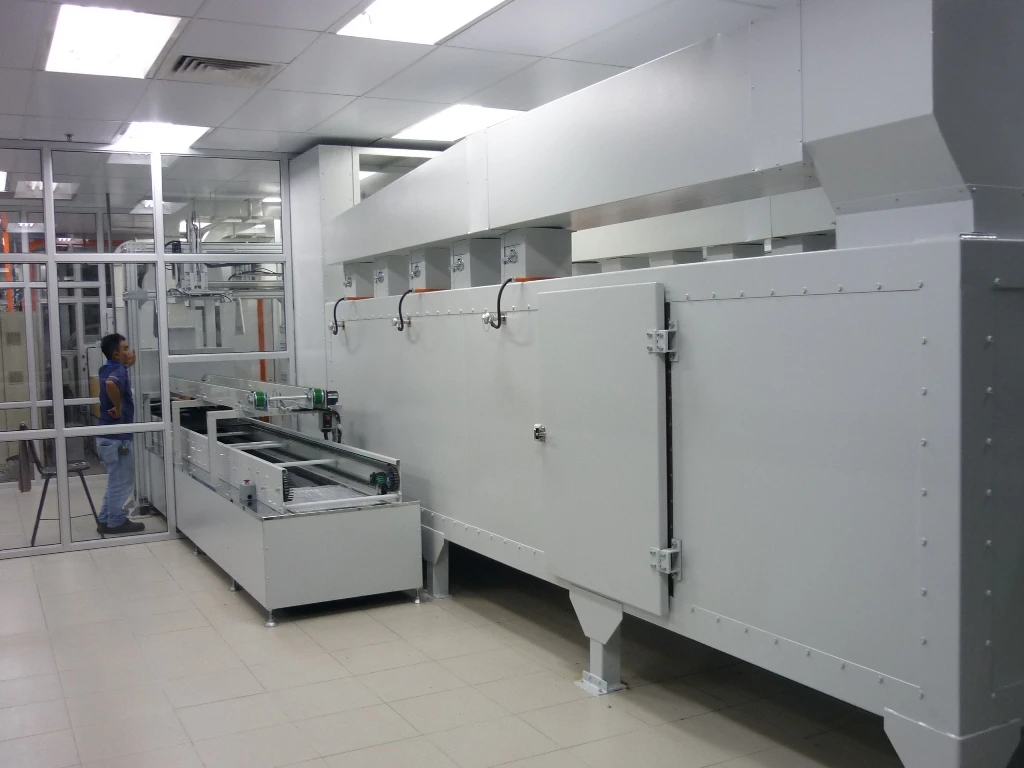
A conveyor oven is an industrial thermal processing system that transports products through a heated environment using a conveyor mechanism.
Products enter the oven, travel through the designated heating area and exit after undergoing the required thermal process. Depending on the design, the system may incorporate different heating zones or connect directly to other manufacturing equipment.
Conveyor ovens are commonly used in production environments where products follow a repeatable manufacturing sequence.
How Does a Conveyor Oven Work?
A typical conveyor oven operates through the following stages:
Product Loading
Products are placed onto the conveyor or an appropriate carrier.
Conveying
The conveyor transports products into the oven.
Thermal Processing
Products pass through the heated area under the specified process conditions
Controlled discharge
Products exit the oven and proceed to the next stage of production.
The conveyor speed, oven temperature, heated length and product spacing must be considered together to achieve the required processing conditions.
Common Applications of Conveyor Ovens
Depending on the system configuration, conveyor ovens may be used for:
Continuous drying of manufactured components
Coating curing in integrated finishing lines
Heating operations within automated production lines
Thermal processing of products with repeatable requirements
Manufacturing processes requiring coordinated material movement
Advantages of Conveyor Ovens
Continuous production flow
Products can enter and exit the oven at regular intervals, supporting a continuous manufacturing workflow.
Integration with production lines
Conveyor ovens can be integrated with upstream and downstream equipment, including coating systems, material handling equipment and other production processes.
Repeatable processing conditions
Controlled conveyor speeds and defined operating parameters help maintain consistent processing conditions when the system is properly designed and operated.
Potential for higher throughput
Conveyor ovens can support high-volume production when the product requirements, heating capacity and conveying speed are appropriately matched.
What Should You Consider When Choosing a Conveyor Oven?
A conveyor oven requires careful coordination between conveyor speed, product spacing, heating capacity and processing time.
Manufacturers should also consider production line stoppages, maintenance access, product changeovers and the impact of the oven on the overall factory workflow.
Batch Oven vs Conveyor Oven: What Are the Key Differences?
Although both systems provide industrial thermal processing, their operating methods and production requirements differ.
| Comparison Factor | Batch Oven | Conveyor Oven |
|---|---|---|
| Operating method | Processes products in individual batches | Transports products through a heated system |
| Production workflow | Intermittent or cycle-based | Continuous or line-based |
| Product loading | Products are loaded for each cycle | Products enter and exit through the conveying system |
| Product flexibility | Often suitable for varied production batches | Best suited to compatible products and defined production requirements |
| Processing time | Determined by the complete batch cycle | Influenced by conveyor speed and heated-zone length |
| Production capacity | Depends on batch size and total cycle time | Depends on line speed, product spacing and system capacity |
| Material handling | Batch loading and unloading arrangements | Conveyor or carrier-based handling |
| Production line integration | Can operate independently or within a larger system | Commonly integrated into a continuous production line |
| Main design considerations | Chamber size, batch load, temperature and cycle duration | Conveyor speed, heated length, product spacing and temperature |
Neither system is automatically better for every manufacturing application. The appropriate choice depends on the products being processed, the required thermal conditions and the intended production workflow.
How to Choose the Right Industrial Oven for Your Factory
Before selecting a batch oven or conveyor oven, manufacturers should assess several important factors.
1. Production Volume and Throughput
- Start by determining how many products need to be processed within a given period.
- A batch oven may suit operations where products are processed in defined groups or production schedules vary. A conveyor oven may be more appropriate when products need to move steadily through a manufacturing line.
- Evaluate the complete processing cycle rather than comparing equipment based on nominal capacity alone.
2. Product Dimensions and Loading Requirements
- Product dimensions, weight and geometry influence the oven design and material handling arrangement.
- For a batch oven, consider the usable chamber dimensions, loading access and arrangement of products within the chamber.
- For a conveyor oven, assess conveyor width, product spacing, carrier design and clearance through the heated section.
- The selected system must accommodate the products while meeting the required processing conditions.
3. Temperature and Processing Requirements
- Different applications require different temperature ranges, heating profiles and processing durations.
- Identify the required operating temperature, acceptable temperature variation, heating time and any cooling or post-processing requirements.
- For coating curing, drying or heat treatment, the oven must be designed around the actual process specifications. Specialised standards and validation requirements should also be considered where applicable.
4. Production Flexibility
- Consider how frequently your products, production schedules or processing requirements change.
- Batch ovens can offer practical flexibility when different products require separate processing cycles.
- Conveyor ovens are often suitable for standardised production where products follow a repeatable process sequence.
- The best arrangement depends on the degree of variation within your manufacturing operation.
5. Factory Layout and Material Handling
- An industrial oven must fit into the wider factory workflow.
- Assess the available floor space, product transfer routes, loading and unloading access, conveyor connections and the location of upstream and downstream equipment.
- For conveyorised systems, consider the oven as part of the overall production line rather than as an isolated piece of equipment.
6. Energy Efficiency and Operating Requirements
- Energy consumption depends on factors such as insulation, operating temperature, heating method, production schedule, loading practices and heat losses.
- For batch ovens, assess the energy required per cycle and how frequently the oven operates.
- For conveyor ovens, consider operating hours, product throughput and the energy required to maintain the necessary process conditions.
- Where appropriate, heat recovery solutions may also be evaluated to determine whether usable waste heat can be recovered from the process.
Can Industrial Ovens Be Customised?
Yes. Industrial ovens can be designed or configured around specific product dimensions, process temperatures, production capacity and material handling requirements.
A batch oven may incorporate customised chamber dimensions, loading arrangements, temperature controls and airflow configurations.
A conveyor oven may incorporate a suitable conveyor design, controlled conveying speed, defined heating zones and integration with other production equipment.
The final configuration should be based on the manufacturing process, product specifications, required thermal cycle, production target and factory layout.
Defining these requirements early helps manufacturers identify a system that meets their operational needs rather than selecting equipment based on external dimensions or advertised capacity alone.
Batch Oven vs Conveyor Oven: Which One Should You Choose?
The right industrial oven depends on how your manufacturing operation is organised.
A batch oven may be suitable when:
Products are processed in defined groups.
Production schedules or product types vary.
Individual processing cycles suit the application.
The chamber and loading arrangement meet your requirements.
A conveyor oven may be suitable when:
Products need to move continuously through the process.
Production requires a coordinated manufacturing line.
Products have compatible dimensions and thermal processing requirements.
The required throughput can be achieved with the proposed conveyor speed and heating-zone design.
If your operation involves different product types, variable processing requirements or multiple manufacturing stages, an engineering assessment can help determine the most appropriate configuration.
The decision should be based on the complete production workflow, including process performance, material handling, operating requirements and future production needs.
Industrial Thermal Processing Solutions by GSE-M Technology
GSE-M Technology Sdn Bhd provides industrial engineering solutions, including batch ovens and conveyorised ovens designed around specific manufacturing requirements.
When developing a thermal processing system, factors such as product dimensions, operating temperatures, processing cycles, production capacity and material handling requirements must be considered to determine an appropriate configuration.
Whether your manufacturing operation requires batch-based heating or a conveyorised production line, selecting the right system begins with understanding your products and production objectives.
Looking for an industrial oven for your production process?
Explore GSE-M Technology’s Thermal Processing solutions to learn more about industrial ovens and customised thermal processing systems.
Frequently Asked Questions
What is the main difference between a batch oven and a conveyor oven?
A batch oven processes a group of products inside a chamber during a defined cycle. A conveyor oven transports products through a heated environment for continuous processing. The main difference is how products are handled and how the oven fits into the production workflow.
Is a batch oven better than a conveyor oven?
Neither is universally better. A batch oven may suit intermittent production, varied product requirements or cycle-based processing. A conveyor oven may suit continuous production and integrated manufacturing lines. The right choice depends on throughput, product dimensions, process conditions and factory layout.
Which industrial oven is suitable for high-volume production?
A conveyor oven can be suitable for high-volume production when product flow, conveyor speed, heating capacity and processing time are compatible. A batch oven may also meet substantial production requirements when its batch capacity and cycle time are appropriately designed. Actual throughput should be calculated for the intended application.
Can a conveyor oven handle different product sizes?
Yes, provided the products fall within the system’s design limits. Product dimensions, weight, spacing, carrier requirements and thermal processing conditions must be assessed during system design. Significant variations may affect the conveyor configuration and production performance.
What factors affect industrial oven operating costs?
Operating costs depend on energy consumption, heating method, insulation, operating temperature, production schedule, maintenance requirements and throughput. A useful comparison considers the resources required to process a defined quantity of products to the required specifications.
What information is needed when requesting an industrial oven?
Useful information includes product dimensions and weight, material type, required operating temperature, processing duration, target production volume, loading method, factory layout and any applicable process or validation requirements. These details help an engineering team assess a suitable oven configuration.