
Selecting the right industrial coating system is essential for manufacturers seeking consistent surface quality, suitable corrosion protection and efficient production processes. The choice depends on the substrate material, product design, coating specifications and intended operating environment.
Three common industrial coating technologies are powder coating, wet paint and electrodeposition (ED) coating. Each uses a different application process and has specific requirements for surface preparation, equipment configuration and curing or finishing.
The main difference between powder coating, wet paint and ED coating is how the coating material is applied to the product. Powder coating uses electrostatically charged powder, wet paint applies liquid coating material, and ED coating uses an electrical process to deposit coating onto conductive components immersed in a coating bath.
Understanding these differences helps manufacturers identify the most appropriate coating technology for their products and production requirements.
What Is Powder Coating?
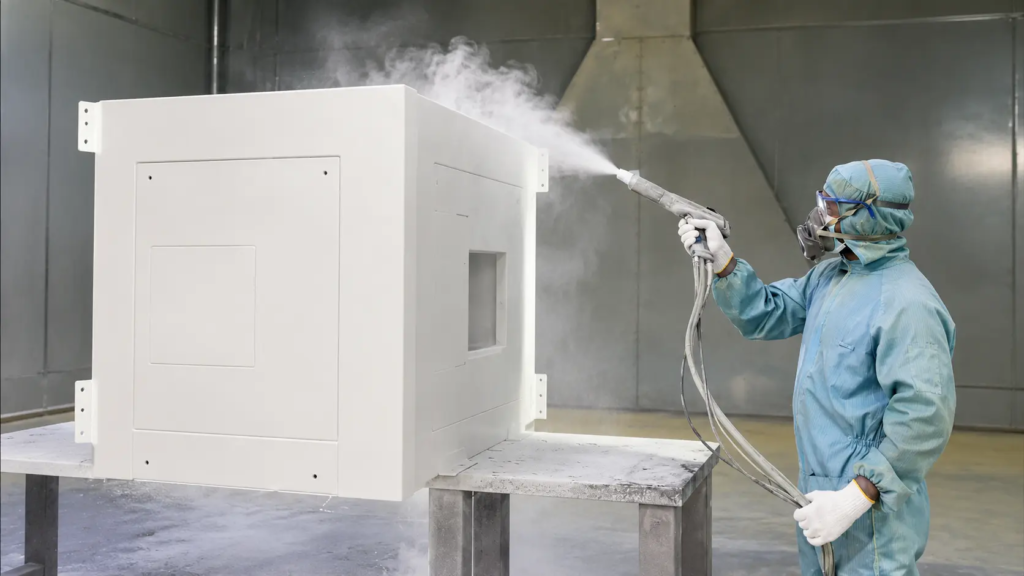
Powder coating is a finishing process that applies dry powder to a prepared surface. In a typical electrostatic powder coating system, the powder particles receive an electrical charge and are attracted to a suitably grounded workpiece.
The coated component then passes through a curing oven, where the powder melts, flows and forms a coating under the specified curing conditions.
Powder coating is commonly used for metal components that require a durable finish, including automotive parts, metal furniture, industrial equipment and other manufactured products.
How Does Powder Coating Work?
A typical powder coating process involves the following stages:

Surface preparation
The workpiece is cleaned and prepared to meet the coating requirements.

Powder application
Powder is applied using suitable spray equipment within a powder coating booth or designated application area.

Curing
The coated component enters an oven for the required curing cycle.

Inspection
The finished coating is checked against the specified quality requirements.
The exact process depends on the substrate, powder formulation, component geometry and required finish.
Advantages of Powder Coating
Durable surface finish
When correctly selected and applied, powder coatings can provide a durable finish suitable for many industrial applications.
Efficient material utilisation potential
Overspray may be recoverable in appropriately designed systems, depending on the powder, equipment and required quality controls.
Range of finish options
Powder coatings are available in various colours, textures and finishes to suit different product requirements.
Suitable for integrated production lines
Powder coating equipment can be integrated with pretreatment systems, conveyors, curing ovens and automated material handling equipment.
Considerations for Powder Coating
Powder coating generally requires a curing process suitable for the selected coating material. Manufacturers must assess the substrate’s ability to withstand the required temperature.
Product geometry, recesses, electrostatic access, grounding, coating thickness and surface preparation also influence the final result.
What Is Wet Paint Coating?
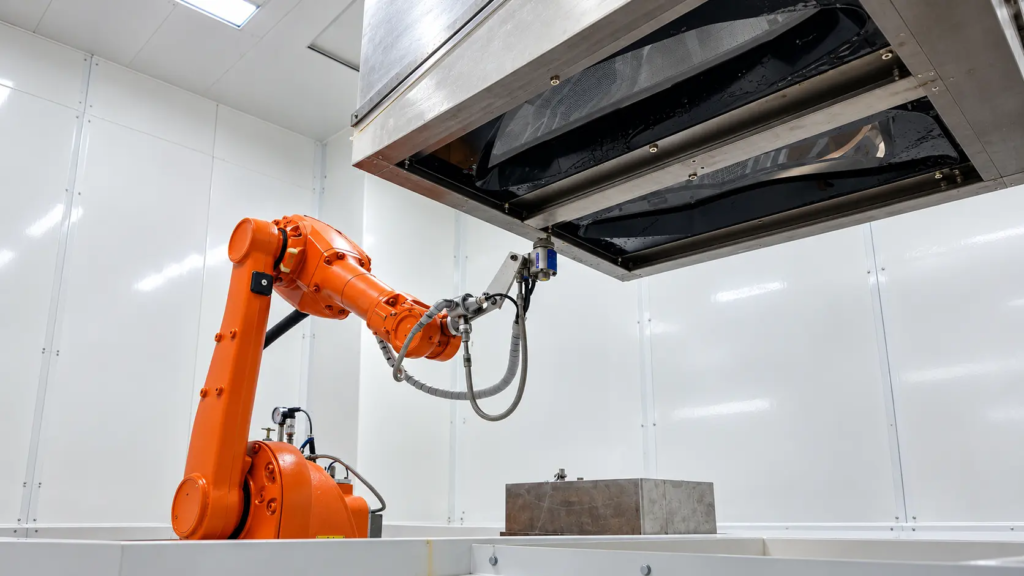
Wet paint coating applies liquid coating material to a prepared surface using methods such as spray painting. The coating forms a film as its carrier evaporates, through chemical curing, or through a combination of mechanisms depending on the paint formulation.
Wet painting is widely used for metal, plastic and other substrates when the selected coating system is compatible with the material and application requirements.
Industrial wet paint systems may include spray booths, paint preparation equipment, ventilation, controlled application areas and suitable drying or curing facilities.
How Does Wet Coating Work?
A typical wet coating process involves the following stages:
Surface preparation
The workpiece is cleaned and prepared for coating.
Paint preparation
The coating material is prepared according to the manufacturer's specifications.
Application
Paint is applied using a suitable spray or other application method.
Drying or curing
The coating develops its required properties under the specified conditions.

Inspection
The finished surface is checked for appearance and compliance with the required specifications.
Depending on the coating system, additional steps such as primer application, intermediate coats or topcoats may be necessary.
Advantages of Wet Paint Coating
Versatility across applications
Suitable liquid coating formulations are available for a broad range of substrates, product geometries and finishing requirements.
Wide range of colours and finishes
Wet paint systems can accommodate different colour specifications, gloss levels, textures and appearance requirements.
Potentially suitable for heat-sensitive substrates
Certain liquid coatings can be processed under conditions that are more suitable for heat-sensitive materials than conventional powder curing. Compatibility must be confirmed for the specific coating and substrate.
Flexible application methods
Depending on the product and coating specification, wet paint can be applied using different spray technologies and finishing arrangements.
Considerations for Wet Paint Coating
Wet painting requires appropriate management of paint preparation, overspray, ventilation, drying or curing conditions and any applicable emissions controls.
Solvent-based coatings may require specific measures for volatile organic compound (VOC) management and fire safety. Water-based coatings have different handling and drying requirements, but still need appropriate process controls.
The coating formulation, application method and facility design should be selected together to meet the required finish quality and environmental obligations.
What Is ED Coating?
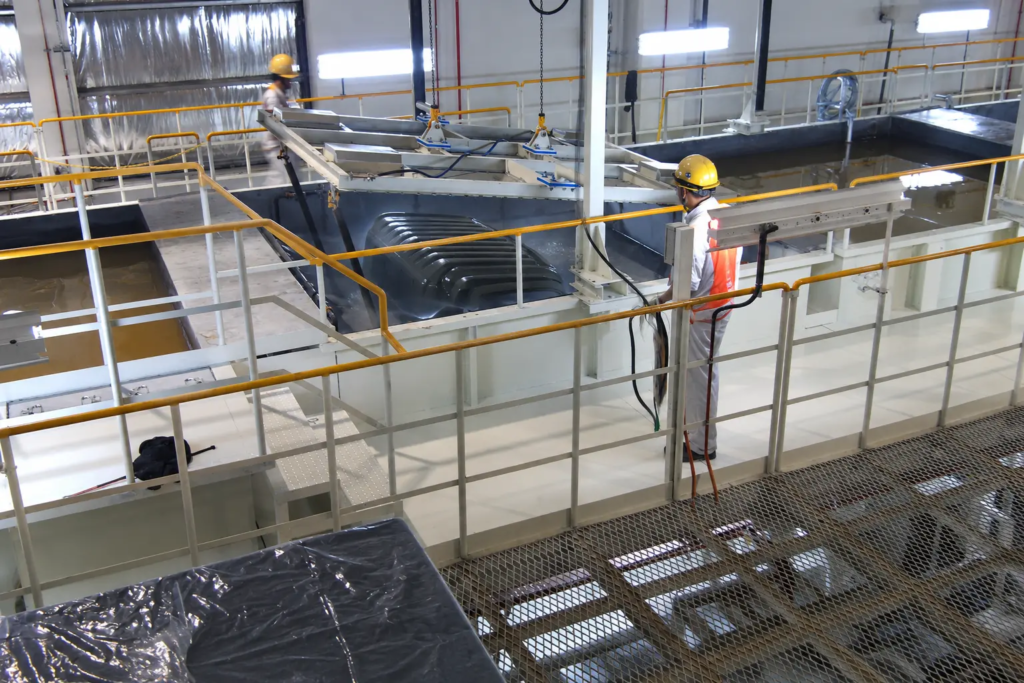
Electrodeposition (ED) coating is an immersion-based coating process that uses an electrical potential to deposit coating material onto electrically conductive workpieces.
The workpiece is immersed in a coating bath, and the electrical process causes coating material to deposit onto its surface. The coated component is subsequently rinsed as required and cured according to the coating specification.
ED coating is widely associated with automotive body and component finishing, where consistent coverage and corrosion protection are important requirements.
How Does ED Coating Work?
A typical ED coating line includes the following stages:
Pretreatment
Components undergo the required cleaning and surface preparation.
Immersion
The workpieces enter a specially formulated coating bath.
Electrical deposition
An electrical potential drives the deposition of coating material onto the conductive surfaces.
Rinsing
Suitable rinsing stages remove excess coating material and support coating quality.
Curing
The deposited coating is cured under the specified conditions.

Inspection
The finished coating is evaluated against the required specifications.
The configuration depends on the coating chemistry, component design, production volume and required performance.
Advantages of ED Coating
Coverage of complex components
The immersion process can coat many complex geometries and recessed areas that may be difficult to reach using conventional spray application. Actual coverage depends on part geometry, bath conditions and electrical access.
Corrosion protection
ED coating is commonly used where corrosion resistance is a key requirement, particularly when the process and coating specification are correctly selected and controlled.
Suitable for automated production
ED coating lines can be integrated with pretreatment stages, immersion tanks, rinsing systems, conveyors and curing ovens.
Consistent process control
Electrical parameters, bath conditions and process controls can be monitored to support repeatable coating application.
Considerations for ED Coating
ED coating generally requires electrically conductive workpieces, specialised tanks, a controlled coating bath and appropriate electrical process equipment.
The system also needs suitable pretreatment, rinsing, bath management and wastewater or process-residue controls. The capital investment, facility requirements and operating complexity should be assessed against the intended production volume and coating performance requirements.
Powder Coating vs Wet Paint vs ED Coating: Key Differences
Although all three technologies are used to apply industrial coatings, they differ in application method, equipment requirements and suitability for particular products.
| Comparison Factor | Powder Coating | Wet Paint | ED Coating |
|---|---|---|---|
| Coating material | Dry powder | Liquid coating | Liquid coating bath |
| Application method | Commonly electrostatic spraying | Spray or other suitable application methods | Electrical deposition during immersion |
| Suitable substrates | Commonly prepared metals; other substrates require a suitable process | Depends on coating formulation and substrate compatibility | Electrically conductive workpieces |
| Curing or drying | Typically requires oven curing | Depends on the coating formulation | Typically requires oven curing |
| Complex geometries | Depends on electrostatic access and application conditions | Depends on spray access and application method | Can provide coverage in many recessed areas |
| Production integration | Can integrate with booths, pretreatment, conveyors and curing ovens | Can integrate with spray booths, conveyors and drying or curing equipment | Can integrate with pretreatment, immersion tanks, rinsing and curing |
| Key considerations | Grounding, powder application, curing temperature and film quality | Coating formulation, application conditions, drying or curing and emissions controls | Bath management, electrical parameters, pretreatment and rinsing |
| Typical applications | Metal furniture, industrial equipment and metal components | Automotive refinishing, industrial components and decorative finishes, depending on the coating | Automotive bodies and components requiring controlled immersion coating |
No single coating technology is best for every application. The appropriate choice depends on the substrate, required coating performance, product geometry, production requirements and available facilities.
How to Choose the Right Industrial Coating System
Before investing in a coating line, manufacturers should evaluate the following factors.
1. Substrate Material
- Start by identifying the material being coated.
- Powder coating is widely used for prepared metal components, although specialised processes may support other substrates. Wet paint offers options for different materials when a compatible formulation is selected. ED coating requires electrically conductive workpieces suitable for the deposition process.
- Substrate compatibility should be confirmed before selecting the equipment and coating material.
2. Required Coating Performance
- Consider the performance requirements of the finished product.
- These may include corrosion resistance, adhesion, abrasion resistance, chemical exposure, appearance and service conditions.
- Different coating formulations provide different properties. The performance of the final coating depends on the entire system, including surface preparation, application, curing and quality control.
3. Product Geometry and Dimensions
- Product shape affects coating access, handling and equipment configuration.
- For powder coating, manufacturers should assess electrostatic access, grounding and the ability to coat recessed areas.
- For wet paint, consider spray access, component orientation and the risk of uneven application or runs.
- For ED coating, evaluate immersion access, drainage, electrical contact and the ability of the process to coat the required surfaces.
4. Production Volume and Throughput
- The required production output influences the design of the coating system.
- Smaller or variable production runs may benefit from flexible application arrangements. Higher-volume operations may require coordinated conveyors, automated application equipment and integrated curing or finishing stages.
- For ED coating, bath capacity, immersion cycles and associated handling equipment also influence throughput.
- The complete production cycle should be evaluated rather than comparing application equipment in isolation.
5. Curing and Drying Requirements
- Coating systems differ in their drying and curing requirements.
- Powder coatings and many ED coatings require a suitable curing oven. Wet paint may air-dry or require controlled heating, depending on the formulation.
- The substrate’s temperature limitations, required coating properties and available processing time must be considered when specifying the heating system.
6. Factory Layout and Environmental Controls
- Coating equipment must fit within the available production space and comply with applicable safety and environmental requirements.
- Consider ventilation, powder collection, paint overspray management, emissions controls, process drainage, wastewater treatment and the movement of products between production stages.
- These requirements vary by technology and coating formulation and should be included in the initial engineering assessment.
7. Total Cost of Ownership
- Equipment cost is only one part of the investment decision.
- Manufacturers should also consider coating material consumption, energy use, labour, maintenance, quality rejects, waste management, facility requirements and production throughput.
- A system with a lower initial purchase price may not necessarily offer the lowest overall operating cost. A comparison should use realistic production conditions and the required coating specifications.
Can Different Coating Technologies Be Combined?
Yes. Some manufacturing operations use multiple coating technologies to meet different functional or appearance requirements.
For example, an ED coating process may be used as a corrosion-protection layer before subsequent finishing stages in applications where the complete coating specification calls for them. Powder coating or wet paint may also be used in multi-layer finishing systems where the substrate, coating compatibility and process requirements allow.
However, these technologies are not automatically interchangeable or suitable for every combination. Coating compatibility, adhesion, curing conditions and the final performance requirements must be evaluated during process design.
Industrial Coating Line Solutions by GSE-M Technology
GSE-M Technology Sdn Bhd provides industrial engineering solutions for coating and surface finishing applications, including powder coating lines, wet paint and spray painting lines, electro-deposition (ED) coating lines, paint shop systems and powder booth systems.
The appropriate system configuration depends on the product being coated, required surface performance, production capacity, material handling and facility requirements.
By evaluating these factors at the engineering stage, manufacturers can identify a coating solution that aligns with their production objectives and process specifications.
Planning a new coating line or upgrading an existing facility?
Explore GSE-M Technology’s Painting solutions to learn more about industrial coating systems and equipment configurations.
Frequently Asked Questions
What is the difference between powder coating and wet paint?
Powder coating applies dry powder to a prepared surface, commonly using electrostatic application, before curing. Wet paint applies a liquid coating that dries or cures according to its formulation. The appropriate choice depends on substrate compatibility, coating performance, appearance and production requirements.
Is powder coating better than wet paint?
Neither is universally better. Powder coating can be suitable for durable finishes on compatible components, while wet paint offers a broad range of formulations and application options. Product geometry, substrate limitations, finish requirements and operating conditions determine the more suitable solution.
What is the difference between ED coating and powder coating?
ED coating deposits material from a liquid bath using an electrical process on conductive workpieces. Powder coating typically applies dry powder through electrostatic spraying before oven curing. Their equipment, process controls and applications differ.
Why is ED coating used in automotive manufacturing?
ED coating is used in many automotive applications because a properly designed and controlled process can provide consistent coating coverage and corrosion protection on conductive components. The actual performance depends on pretreatment, coating chemistry, process conditions and the specified coating system.
Can powder coating be used on plastic?
Conventional powder coating often requires curing temperatures that many plastics cannot withstand. Specialised low-temperature or alternative powder coating processes may be possible for suitable substrates. Compatibility must be verified for the particular material and coating system.
What should manufacturers consider before investing in a coating line?
Important factors include substrate material, coating performance, product dimensions, production volume, application method, curing requirements, factory layout, environmental controls and total operating costs. An engineering assessment helps determine the appropriate system configuration.